
 Pátý ročník semináře pro středoškolské studenty i jejich učitele Chemie na ČVUT se blíží. Čeká vás řada zajímavých přednášek odborníků z ČVUT a laboratorní cvičení. Registrace na akci je otevřená do naplnění kapacity. Těšíme se na Vás ve čtvrtek 16. listopadu.
Studentský den nukleární medicíny
Vážené kolegyně, vážení kolegové,
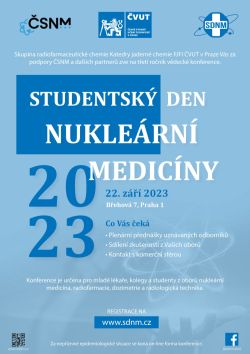
dovolte nám vás jménem organizačního výboru pozvat na třetí ročník studentské vědecké konference Studentský den nukleární medicíny, která se uskuteční 22. září 2023 v prostorách Fakulty jaderné a fyzikálně inženýrské ČVUT v Praze. Tato konference je věnována studentům bakalářského, magisterského a doktorského stupně studia a dále mladým pracovníkům z oborů souvisejících s využitím radionuklidů v přírodních vědách, radiofarmacií, radiologickou fyzikou a medicínskou technikou, radiologickým asistentům a mladým lékařům zaměřujícím se na nukleární medicínu, či využívající její metody.
Můžete se těšit na bohatý program plný zajímavých informací, setkání se s dalšími lidmi z oboru a třeba navážete i zajímavou spolupráci. Díky finanční podpoře ČVUT v Praze je účast pro studenty ČVUT zdarma. Více informací se můžete dozvědět na stránkách Studentského dne nukleární medicíny nebo v přiloženém letáku. Registrace a příjem abstraktů je do 7. srpna 2023.
Všichni jste srdečně zváni a těšíme se na vás.
Organizační výbor SDNM
Týden vědy na Jaderce
Od 18. června 2023 probíhá na FJFI akce pro středoškoláky Týden vědy na Jaderce. Pracovníci katedry jaderné chemie si pro tuto akci připravili dvě přednášky:
- RNDr. Martin Vlk, Ph.D.: Moderní radiofarmaka v diagnostice a terapii (neděle 18.6.2023 14:00 v B314)
- Ing. Alena Zavadilová, Ph.D.: Stanovení uranu v přírodních vodách (pondělí 19.6.2023 v 16:30)
a také několik miniprojektů:
- 30. Chemické změny v důsledku ozáření – radiační chemie a fotochemie (Ing. Jan Bárta, Ph.D.)
- 43. 99mTc značené léčivé přípravky pro diagnostiku v nukleární medicíně (Ing. Tereza Janská)
- 45. Radioimunoanalýza (Bc. Matěj Štíbr)
- 65. Kde se berou radionuklidy? (Ing. Miroslava Semelová, Ph.D.)
Těšíme se na vaši účast!
INI 2023
Ve dnech 24. a 25. května proběhla na katedře jaderné chemie a na katedře dozimetrie pravidelná praktická část čtyřtýdenního mezinárodního kurzu INI pro pracovníky a studenty v jaderném sektoru. Kurz INI pořádá ČVUT ve spolupráci s University of Massachusetts Lowell a je podporována Mezinárodní agenturou pro atomovou energii.
Zemřel prof. Ivo Zvára
Dne 27. 12. 2021 ve věku 87 let zesnul dlouholetý spolupracovník SÚJV Dubna profesor Ivo Zvára odborník v oblasti syntézy a chemické identifikace transaktinoidů.
Fourth A-CINCH webinar „Safety of future reactors (Gen IV) – A story from the past and present“
Safety of future reactors (Gen IV) – A story from the past and present
Prof. Teodora Retegan Vollmer
Department of Chemistry and Chemical Engineering
Chalmers University
Moderator: Prof. Mario Mariani, Politecnico di Milano
Abstract
The purpose of the presentation is to give insight into the reactor safety from a chemical point of view for Gen II-III and Gen IV Reactors. The physical barriers set up for a safe functioning of a nuclear reactor are (generally): the fuel matrix, the cladding, and the coolant (light or heavy water, gas, molten metals like Lead-Bismuth eutectic or LBE, Pb, other for the more advanced systems) as well as the reactor vessel, primary containment and the secondary containment. Each barrier and the chemical processes accompanying the potential release of radionuclides (or retention) will be briefly explained and the overall aim is to give a general view over the processes governing the release path for radionuclides, as well as the mitigation measures.
Here you can find a brief presentation of the speaker: http://www.chalmers.se/en/
Please fill in the participation form https://docs.google.com/forms/
To attend the event:
Internship opportunities at the European Organization for Nuclear Research (CERN)
The European Organization for Nuclear Research (CERN) in Geneva would like to ask your help to promote our Administrative, Technical and Doctoral Student Programme to your students.
ADMINISTRATIVE and TECHNICAL STUDENT PROGRAMMES:
The selected students have the chance to spend 2 to 12 months (Administrative Student Programme) or 4 to 12 months (Technical Student Programme) at CERN and to get involved in the day-to-day work of our multicultural and multidisciplinary teams and to work on interesting projects with some of the brightest minds in their fields. This internship allows them to complete their bachelor or master thesis at CERN. Students who apply to those two Programmes should have completed at least 18 months of undergraduate studies (Bachelor or Master’s) at the time of the next selection committee taking place in December 2021 and they need to remain registered as a full-time students during the whole period of their internship.
DOCTORAL STUDENT PROGRAMME:
The selected students have the chance to spend 6 to 36 months at CERN. Students have started or are about to start a doctoral programme in an university. Their work envisaged at CERN is all or part of the thesis work required to obtain their PhD. The award of the degree remains the responsibility of their university. Academic arrangements will be discussed between students’ university thesis supervisor and students’ CERN supervisor.
We hire in these fields:
Administrative Student Programme: translation, human resources, advanced secretarial work, business administration, logistics, law, finance, accounting, library and information science, engineering management, science communication, education, audiovisual, communication and public relations, psychology, audit are but a few examples of the many domains in which successful applicants will learn and contribute their knowledge.
Technical Student Programme: applied physics; electrical or electronics engineering; general or civil engineering; IT, mathematics and robotics; material and surface science; mechanical engineering.
Doctoral Student Programme: applied physics, engineering or computing.
The deadline for application for Administrative, Technical and Doctoral Student programme is October 11, 2020 at 12pm (12 noon CET).
IAEA Marie Sklodowska-Curie Fellowship Programme (MSCFP)
The IAEA Marie Sklodowska-Curie Fellowship Programme (MSCFP) aims to help increase the number of women in the nuclear field, supporting an inclusive workforce of both men and women who contribute to and drive global scientific and technological innovation. The Programme seeks to inspire and encourage young women to pursue a career in the nuclear field, by providing highly motivated female students with scholarships for Master’s programmes and an opportunity to pursue an internship facilitated by the IAEA.
Scholarships are awarded annually, with up to 100 female students selected per year depending on the availability of funds. Consideration is given to geographic, field of study and linguistic diversity. The selected students are awarded up to €20,000 for tuition costs and up to €20,000 for living costs for the duration of their Master’s programme.
More information here!
Mezinárodní spolupráce při aplikaci metody AMS v radioekologii (AMSIR)
Cílem projektu mezinárodní mobility pro studenty a učitele „Zlepšení znalostí a schopností studentů a pedagogů při aplikaci metody AMS v radioekologii (AMSIR)“ je ustavení dvoustranné spolupráce mezi Norwegian University of Life Sciences (NMBU) a Katedrou jaderné chemie FJFI ČVUT v Praze. Projekt je zaměřen na propojení radioekologie a urychlovačové hmotnostní spektrometrie a vzájemné výměně znalostí a dovedností v těchto oblastech. V rámci projektu jsou plánovány semináře, exkurze a vzájemné návštěvy na pracovištích. Poskytovatelem projektu je Dům zahraniční spolupráce (www.dzs.cz) v rámci EHP projektů spolupráce s Norskem pod projektovým číslem EHP-CZ-MOP-2-010. Tematicky je projekt propojen s budováním laboratoře AMS v projektu RAMSES. .
The MOOC “ESSENTIAL RADIOCHEMISTRY FOR SOCIETY” is online!
“ESSENTIAL RADIOCHEMISTRY FOR SOCIETY” is the new MOOC available on the POK-Politecnico Open Knowledge platform (https://www.pok.polimi.it/) addressed to everyone interested in understanding why Nuclear- and Radio-Chemistry are so important and so present in everyday life.
The course, online and free of charge, was born within the European project MEET-CINCH “a Modular European Education and Training Concept In Nuclear and radioCHemistry 2016-2020” (https://www.cinch-project.eu/). It is developed around five application areas of nuclear- and radio-chemistry (for the environment, for health, for industry, for nuclear energy, for society), and is addressed in particular to Bachelor students in scientific areas, who are interested in realising the involvement of Nuclear- and Radio-Chemistry in everyday life for understanding the advantages they could introduce. Indeed, Nuclear- and Radio-Chemistry are certainly needed in addressing many of the current societal challenges related to health, environment, clean energy and food.